English| EUR
Suggested for you
More currencies
Choose a language
The train from Milan to Interlaken connects Italy's urban heart with the gateway to the Bernese Oberland. Your journey involves at least one transfer, typically through Brig or Spiez, and the total travel window depends on which departure you choose and how the connections align. This guide maps out the routes, explains the station handoffs, and shows you how to book tickets that work with Swiss and Italian rail systems.
Quick answer
The Milan to Interlaken train time ranges from 4 to 5 hours depending on your route and connection. Most travelers depart from Milano Centrale and transfer once—either in Brig or Spiez—before arriving in Interlaken Ost or Interlaken West. Morning departures between 7:00 and 9:00 offer the most daylight for alpine views through the Simplon Pass and Lötschberg corridor. Trains run daily year-round, with timetables managed by Trenitalia and Swiss Federal Railways (SBB).
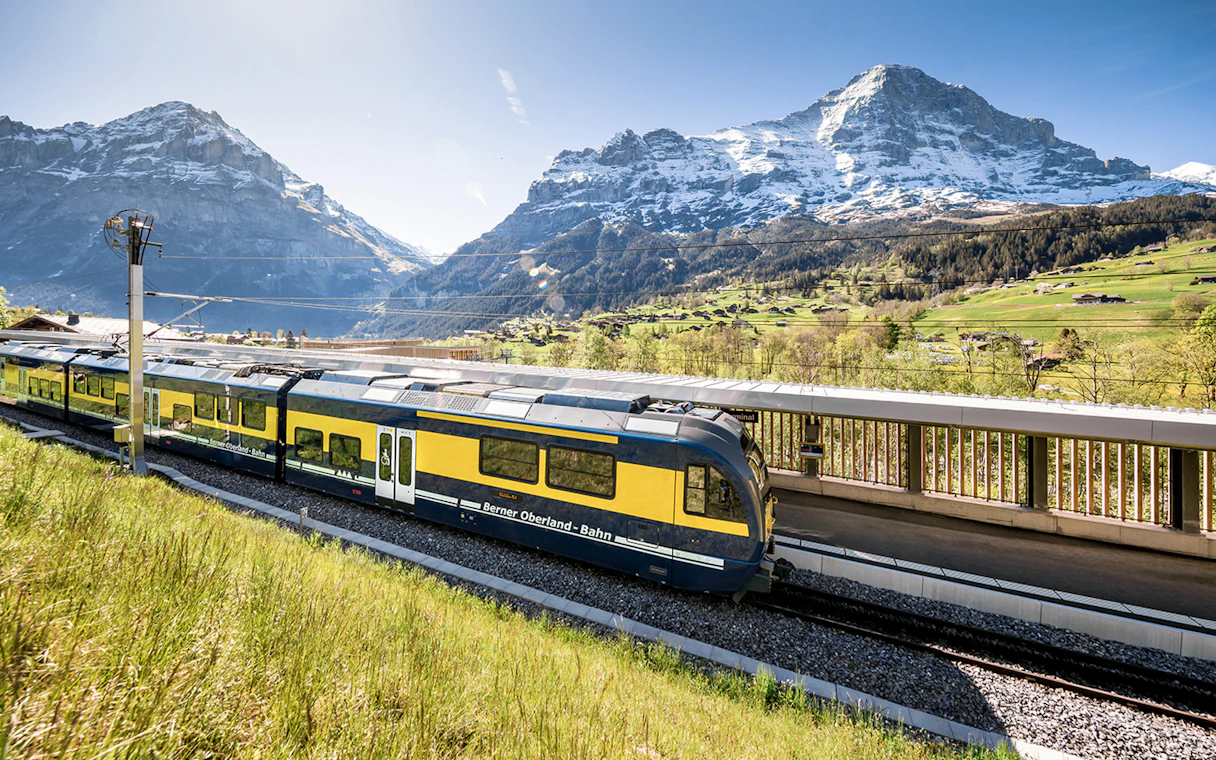
The journey begins at Milano Centrale, a monumental Fascist-era terminal whose vaulted ceilings and marble halls serve as the starting point for one of Europe's most scenically varied rail routes. Trains depart throughout the day, threading north through Lombardy's industrial plain before climbing into the Ticino valley and crossing into Switzerland at Chiasso or Domodossola. The route you take determines not only your milan to interlaken train time but also the landscape you encounter: the western corridor through Brig follows the historic Simplon railway, a 20-kilometer tunnel completed in 1906 that punches beneath the Alps at nearly 700 meters below the surface, while the eastern path via Spiez curves along the shore of Lake Thun, offering unobstructed views of the Eiger, Mönch, and Jungfrau massifs. Most itineraries require a single transfer, typically in Brig or Spiez, where Swiss precision meets Italian spontaneity in the form of tightly coordinated connections. The SBB network synchronizes arrivals and departures down to the minute, so a 6-minute layover is not a gamble but standard operating procedure. Platform signage switches from Italian to German at the border, and conductors begin checking both tickets and Swiss Travel Passes as you enter the fare zone governed by the Berner Oberland Bahn and Zentralbahn. The rail corridor narrows as you approach Interlaken, flanked by forests of spruce and larch that open suddenly onto the turquoise plane of the Aare River. Booking is handled through multiple systems. Trenitalia sells tickets for the Italian segment, SBB manages the Swiss network, and cross-border fares are available through both platforms as well as third-party aggregators like Omio and Trainline. Reservations are not mandatory on this route, but seat assignments are recommended during summer weekends and holiday periods when Milanese day-trippers fill the northbound morning trains. The fare structure distinguishes between point-to-point tickets and integrated passes; if you plan to explore the Jungfrau region beyond Interlaken, the Swiss Travel Pass or Berner Oberland Pass may offer better value than individual segment purchases. The best travel window for scenery runs from early morning through late afternoon. Departures between 7:00 and 9:00 position you to cross the high Alps in full daylight, when snow cover and glacial faces catch the sun. Evening trains sacrifice views for lower fares, and the Simplon tunnel becomes a 20-minute blackout rather than a cinematic descent. The address for your departure point is Milano Centrale, Piazza Duca d'Aosta, 1, 20124 Milano MI, Italy. Trains operate daily from 00:00 to 23:59, though overnight services are rare and require two or more transfers. Official timetables, real-time updates, and integrated ticketing are managed at https://www.sbb.ch, where you can compare routes and lock in reservations up to 90 days in advance.
“The Simplon tunnel punches beneath the Alps at nearly 700 meters below the surface, turning a two-day mountain crossing into a 20-minute passage.”
The standard Milan to Interlaken journey takes approximately 3 hours 45 minutes to 4 hours 30 minutes, depending on connection times. Most routes involve one transfer at Spiez or Brig, with the landscape shifting from Lombardy plains through the Simplon corridor into the Bernese Oberland.
Board a EuroCity train bound for Brig or Domodossola, settling in for the initial leg across the Italian lake district. Departures run hourly throughout the day.
The train climbs through the southern Alps, passing Stresa and the shores of Lake Maggiore before entering Swiss territory. Window seats on the right offer the best lake views.
Most routes require a quick platform change at Brig station, with connection windows typically 8 to 15 minutes. Follow signs for trains toward Interlaken Ost.
The connecting train threads the Lötschberg Base Tunnel or the older mountain route via Kandersteg, emerging along the shores of Lake Thun. The final 30 minutes trace the northern lakeshore.
Step off into Interlaken Ost station, the eastern gateway to the town and the hub for onward connections to Jungfraujoch and Lauterbrunnen. The entire journey covers roughly 250 kilometers.
The journey from Milan to Interlaken departs from Milano Centrale, located at Piazza Duca d'Aosta, 1, 20124 Milano MI, Italy. Travelers typically navigate this route via a combination of international rail services connecting through Spiez or Brig.
EuroCity or Frecciarossa to Brig or Domodossola
Regional or InterCity transfer to Spiez
InterCity or regional train to Interlaken Ost
For the best views of the Alps, aim for the best arrival window of 07:00–21:00. Please note that this is a public transportation route, not a gated attraction, and there is an entrance fee of 0 EUR.
The best arrival window for this journey is 07:00–21:00, as daylight hours provide visibility of the alpine landscape along the route. Aligning your transit with these hours ensures you can see the terrain transitioning from the Italian plains to the Swiss Alps.
Warm, 20°C to 28°C
Long daylight hours maximize viewing time during the transit.
Mild, 10°C to 18°C
Snow remains on higher peaks while lower valleys begin to bloom.
Cool, 8°C to 16°C
Clearer air often provides high visibility for mountain scenery.
Cold, -2°C to 7°C
Reduced daylight hours limit the viewing window for alpine vistas.
Verdict: For optimal scenic value, plan your trip between April and October to utilize the extended daylight within the 07:00–21:00 arrival window.
The journey from Milan to Interlaken operates via public rail infrastructure, meaning there is no singular admission fee for the route. Costs depend entirely on the specific fare class, booking lead time, and selected rail passes.
Verdict: Ticket prices fluctuate based on demand and booking time, so users should consult the official SBB website for the most accurate current fares.
Cross-border train travel requires valid documentation and advance ticket booking to secure your seat.
Everything you need to know about milan to interlaken train time
Travelers typically find the milan to interlaken train time ranges between 3 to 4 hours depending on connections. This journey through the Swiss Alps involves transferring at stations like Spiez or Brig.
While advance booking is not strictly required for the milan to interlaken train time, it is recommended to secure your preferred departure. Booking ahead ensures you have a seat on busier regional lines.
The most common path for the milan to interlaken train time involves crossing the Simplon Pass or the Gotthard route. These tracks provide scenic vistas of the surrounding mountain peaks and valleys.
Currently, no direct trains operate for the milan to interlaken train time, as all routes require at least one connection. Most itineraries are coordinated by the Swiss Federal Railways to minimize waiting between transfers.
The best arrival window for this route is 07:00–21:00 to maximize daylight views of the Alps. Traveling during these hours ensures you see the landscape transition from the Italian plains to Swiss alpine scenery.
Most international and Swiss rail passes are valid for this route. You should check the validity of your specific pass on the official site before boarding the train.
Milano Centrale is equipped with various passenger facilities, including left-luggage offices for those needing storage. The station is located at Piazza Duca d'Aosta, 1, 20124 Milano MI, Italy.